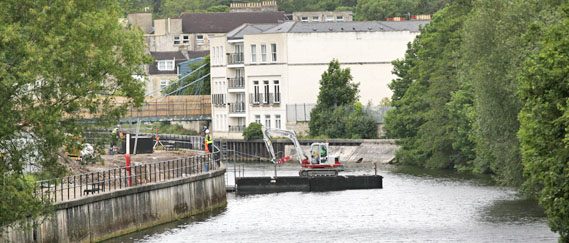
Victoria Bridge over the Bristol Avon in Bath... long term problems: Picture by Bob Naylor©
The problems of historic Victoria Bridge over the Bristol Avon in Bath have rumbled on in recent years and many observers mistakenly believed that with developers Crest Nicholson making it the centre-piece of their controversial riverside development it would be returned to its original splendour — but it appears not. Historian and Queen of Waters author, Kirsten Elliott, has watched the unfolding of the whole sorry saga at close quarters...

What a tangled web Bath & North East Somerset (B&NES) has managed to weave over Victoria Bridge... and the ducking and diving continues.
I lodged a Freedom of Information request at the beginning of December which was finally complied with — an hour before the deadline — and then only because I had chased it. The full report, which was allegedly put in the post that day, actually arrived a week later.
'It is a very old structure' say B&NES
The information I already had made interesting reading — but what followed was an exercise in compare and contrast — between what I had been sent and what is on the B&NES website. On the website we are told that one challenge is that it is a ‘very old structure’ — as though that in some way is an excuse for its present sorry state.
The railway line from Paddington to Bristol runs happily over bridges of similar date, and there are even older bridges and aqueducts on our canal system — but unlike this one — they have been properly maintained.
The railway line from Paddington to Bristol runs happily over bridges of similar date, and there are even older bridges and aqueducts on our canal system — but unlike this one — they have been properly maintained.
‘Key component of landmark contemporary scheme’
 |
| Victoria Bridge: The vision — far removed from the reality |
There seems little doubt that B&NES thought that Crest Nicholson would ride to the rescue of the bridge.
Early documentation promised: 'as a key component of this landmark contemporary scheme’ there will be ‘two new bridges and the restoration of the listed Victoria Bridge.’
The planning document of March 2008 listed developer contributions and promised a ‘strengthened and enhanced Victoria Bridge... and a new pedestrian and cycle bridge to Norfolk Crescent'.
The council website now says, reprovingly: ‘it would be unlawful for the Council to attempt to secure money through a Section 106 Agreement for the structural repair of the bridge as it was a pre-existing part of the highway network.’
Silly old us for believing what we were told!
Silly old us for believing what we were told!
Bridge deteriorated suddenly
Now the bridge has deteriorated quite suddenly. Dealing as I do with old buildings, I can believe it. Neglect something for long enough, let decay get a hold — and it will collapse quite fast. But why has this happened? It is clear that B&NES has not subjected the bridge to adequate inspections.
According to the information I have been sent as a result of my FoI request an inspection in 2007 detected no defects. This is odd, because in 2009 a report by R Griffiths of the University of Bath mentioned that in the past one of the chains had failed — and there is an obvious repair. This would suggest that, given that it is made of wrought iron, in depth checks would have been a good idea... but not, it seems, to B&NES.
In October, 2010, it was found that the bridge was ‘under strength for pedestrian crowd loading' and the report adds ‘for the safety of the public the hoarding was erected to maintain a limited passage for pedestrians.’
Why massive hoardings were felt necessary remains unexplained — but the council insists this was on good advice.
Why massive hoardings were felt necessary remains unexplained — but the council insists this was on good advice.
Strain caused by 'wind-tunnel effect' and 'dead load'
 |
| The recent reality — highly wind resistant and heavy boarding in place on the bridge: Picture by Bob Naylor© |
Since the Griffiths report goes on at some length about the strain caused by the wind tunnel effect and how Dredge’s design minimised this. You might have thought that someone would have asked themselves if this was a good idea — but they didn’t. Once the hoarding was no longer ‘required’, it was removed ‘to reduce the dead load on the existing structure’ — in other words, the bridge is not strong enough to take pedestrians so we’ll put even more load on it by adding hoardings — even though we know that this is putting more load on it.
Paint hid faults
In November it occurred to B&NES that the paint might be hiding something — and so it proved. But how many supports have failed? If you believe the website, then there was ‘further deterioration of one of the central hangers’. This, we are told ‘is a serious issue as any weakness in the central area of the bridge increases the risk to the structure.’
The bridge is a double cantilever so this assertion is, in fact, completely wrong — there is virtually no strain on the centre chains at all. The FoI response I have had tells me that nine out of 10 hangers have failed — a somewhat different story.
The bridge is a double cantilever so this assertion is, in fact, completely wrong — there is virtually no strain on the centre chains at all. The FoI response I have had tells me that nine out of 10 hangers have failed — a somewhat different story.
Missing £80,000
There are three further points that occur to me. The Griffiths report stated how important the foundations on the south side were to the whole structure. This is exactly where Crest Nicholson has been happily 'digging about' – so if they have caused the sudden deterioration, shouldn’t they be liable? The council tells us that they have negotiated with Crest Nicholson a sum of £480,000 for paving and painting in the area of the bridge.
Only a year ago this amount was said to be in the region of £560,000. What happened to the missing £80,000? Finally, the council website assures visitors that B&NES has been liaising with English Heritage over the restoration. In that case, why didn’t they remove all the ivy and buddleia from the arches on each side, when English Heritage asked them to? In fact, there have been repeated requests, which only now have been complied with.
This doesn’t look like a caring council to me —Victoria Bridge should be a potent symbol of Bath’s creativity — instead it proves just how incompetent B&NES can be.

Kirsten Elliott is a freelance print and broadcast journalist who contributes to BBC Network Radio and to local and national newspapers and magazine. She works as an architectural consultant and historian. She is a member of the History of Bath Research Group and the Bath Minuet Company. She has written or co-written seven books on the city, including 'The Illustrated History of Bath'.
Her most recent work, 'The Queen of Waters' — which she produced to commemorate the 200th Anniversary of the Kennet & Avon Canal— is available from the KAcanalTIMES bookstore: Queen of Waters